Abstraction: The Timeless Skill Behind Great Software
Software changes constantly.
Programming languages evolve. Frameworks rise and disappear. New tools promise to make development faster. Artificial intelligence can now generate code, explain systems, and automate tasks that once required hours of work.
Yet one skill remains essential across every generation of technology:
Abstraction is one of the deepest ideas in software engineering. It allows us to manage complexity, communicate intent, and build systems that are larger than anything one person could fully understand.
This idea is central to Structure and Interpretation of Computer Programs, often called SICP. The book presents programming as more than writing instructions for a machine. It describes programming as the process of building useful mental models and combining them into more powerful ones.
That is the real strength of abstraction.
It lets us create simple ideas on top of complex foundations.
What is abstraction?
Abstraction means hiding details that are not currently important while exposing the information that is useful.
It allows us to focus on what something does instead of thinking about how every part works internally.
Consider a car.
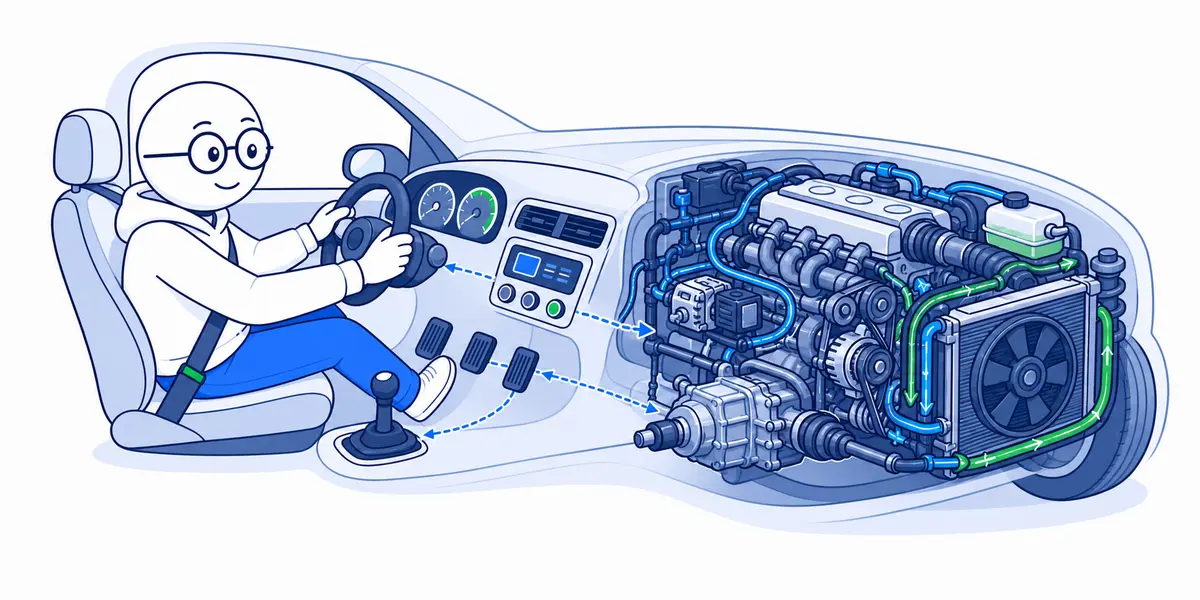
A driver uses a steering wheel, pedals, and a few controls. They do not need to understand combustion, fuel injection, electrical systems, or the exact movement of every mechanical part.
The complexity still exists.
It is simply hidden behind an interface that is easier to use.
Software works in the same way.
When we call a method, use a library, send a request to an API, or work with a programming language, we rely on layers of abstraction.
Each layer gives us a simpler way to reason about the layer below it.

Abstraction exists at every level of computing
One of the most interesting things about abstraction is that it appears throughout the entire computing stack.
At every level, one system hides details and presents a more useful model to the level above it.
Let us start from the bottom.
Electrical signals
At the physical level, a computer is an electronic machine.
Its processors and memory are built from circuits that react to electrical signals. These signals can represent different states, which are commonly simplified as:
On
Off
Those states can then be represented as binary values:
1
0
This is already an abstraction.
A 1 is not electricity itself. It is a convenient symbol that represents a physical state in a circuit.
From these two values, computers can represent numbers, text, images, sound, instructions, and complete software systems.

Machine code
Processors execute instructions encoded as binary values.
A sequence of bits may tell the processor to move data, compare values, perform arithmetic, or jump to another instruction.
Machine code is designed for the processor, not for humans.
A machine instruction may look like this:
10110000 00001010
To the processor, this has a precise meaning.
To most people, it is difficult to read, remember, and maintain.
This creates a problem: humans need a better way to express low-level instructions.
That is where assembly language becomes useful.

Assembly language
Assembly language gives readable names to machine instructions.
Instead of writing raw binary, a programmer can write commands such as:
MOV AX, 10
ADD AX, 5
The first instruction places the value 10 into a processor register called AX.
The second instruction adds 5 to the value stored in that register.
The processor does not execute the words MOV and ADD directly. A program called an assembler translates them into the machine instructions understood by the processor.
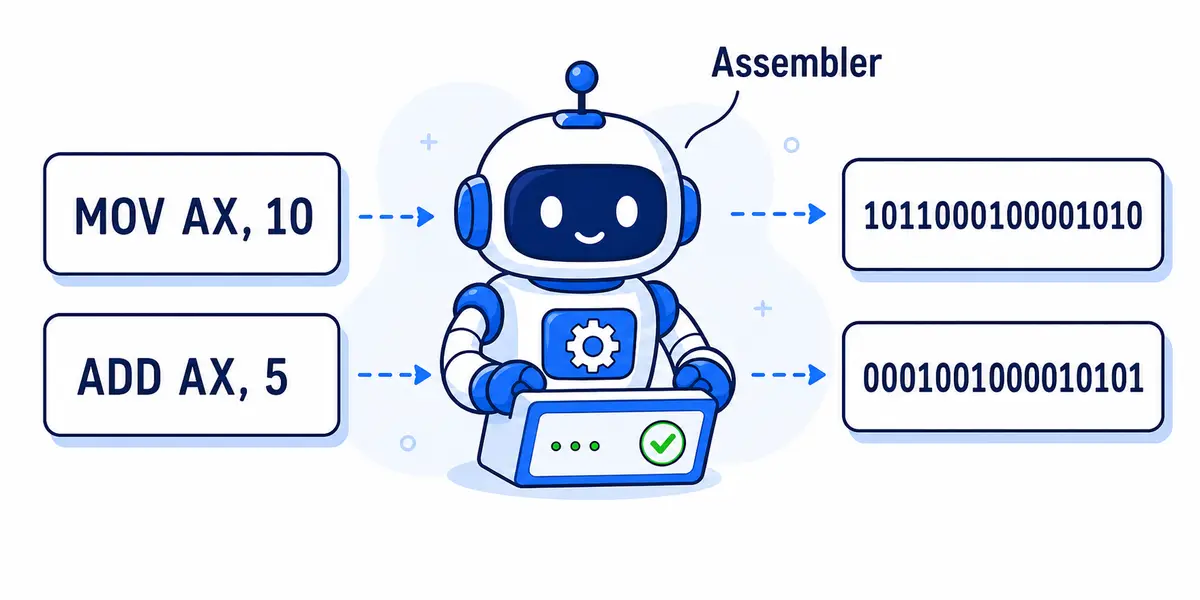
Assembly is therefore an abstraction over machine code.
It does not hide the hardware completely. The programmer still works with registers, memory addresses, processor instructions, and the architecture of the machine.
However, it replaces difficult numeric instructions with symbols that are easier for humans to understand.
The progression now looks like this:
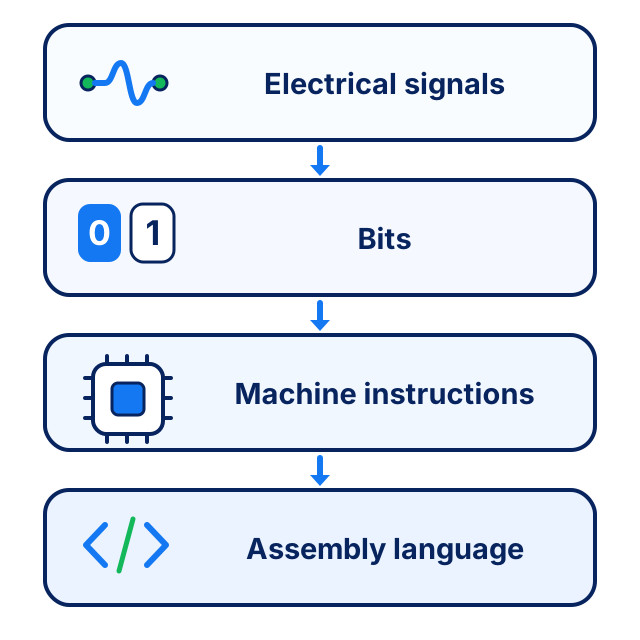
Each step gives us a clearer language for describing the same underlying machine.
Assembly made low-level programming more practical, but developers still needed to manage many hardware details directly. High-level programming languages introduced another major layer of abstraction.

High-level programming languages
Languages such as C#, Java, Rust, Python, and JavaScript allow developers to express ideas in a form that is much closer to human reasoning.
Instead of moving values between processor registers, we can write:
int result = 10 + 5;
Console.WriteLine(result);
The C# compiler translates this code into lower-level instructions.
The developer does not need to know which registers are used, how the values are stored, or which machine instructions perform the addition.
The language hides those details.
More importantly, high-level languages give us richer building blocks:
int
string
bool
decimal
They also give us control structures:
if
for
while
switch
And they allow us to create our own concepts:
Customer
Order
Invoice
Payment
This is a powerful change.

From language building blocks to meaningful concepts
Primitive types are useful, but real software is built from concepts.
Imagine that we are building an online store.
We may begin with simple values:
string customerName = "Alice";
decimal totalAmount = 149.99m;
bool isPaid = false;
These values work, but they do not yet express much structure.
We can group them into a meaningful model:
public sealed class Order
{
    public string CustomerName { get; init; } = string.Empty;
    public decimal TotalAmount { get; init; }
    public bool IsPaid { get; private set; }

    public void MarkAsPaid()
    {
        IsPaid = true;
    }
}
Now the code describes an Order.
That is an abstraction.
The class combines data and behaviour into a single concept that matches the business domain.
Instead of reasoning about unrelated strings, numbers, and Boolean values, we reason about an order.

Functions and methods are abstractions
A function gives a name to a process.
Consider this method:
public decimal CalculateTotal(
    decimal price,
    int quantity,
    decimal taxRate)
{
    decimal subtotal = price * quantity;
    decimal tax = subtotal * taxRate;

    return subtotal + tax;
}
The method hides the individual calculation steps behind a clear name:
decimal total = CalculateTotal(25m, 3, 0.2m);
The caller does not need to repeat or remember the calculation.
The method communicates intent.
This is one of the simplest and most important forms of abstraction in programming: taking a process, giving it a name, and making it reusable.

Types can protect important rules
A good abstraction does more than reduce repetition.
It can also protect the rules of a system.
Earlier, we introduced an Order with a customer name, a total amount, and a payment state.
That structure describes the data, but it should also prevent invalid orders from being created.
For example, every order must have a customer name, and its total amount cannot be negative.
We can protect those rules inside the type:
public sealed class Order
{
    public string CustomerName { get; }
    public decimal TotalAmount { get; }
    public bool IsPaid { get; private set; }

    public Order(string customerName, decimal totalAmount)
    {
        if (string.IsNullOrWhiteSpace(customerName))
        {
            throw new ArgumentException(
                "A customer name is required.",
                nameof(customerName));
        }

        if (totalAmount < 0)
        {
            throw new ArgumentOutOfRangeException(
                nameof(totalAmount),
                "The total amount cannot be negative.");
        }

        CustomerName = customerName;
        TotalAmount = totalAmount;
    }

    public void MarkAsPaid()
    {
        IsPaid = true;
    }
}
Now a valid order can be created and paid through clear operations:
Order order = new("Acme Corp", 129.99m);
order.MarkAsPaid();
The constructor rejects a blank customer name or a negative total before an invalid Order can be created through its public API.
The payment state is also protected because it can change only through MarkAsPaid.
The abstraction makes the code safer and more expressive.

Interfaces separate intent from implementation
As systems grow, we often want to describe what a component should do without depending on the details of how it does it.
In C#, interfaces provide one way to express this.
An interface acts as a contract between code that needs a capability and code that provides it.
The contract defines which operations are available, the inputs they accept, and the results they return.
public interface IPaymentGateway
{
    Task<PaymentResult> ChargeAsync(
        Money amount,
        CancellationToken cancellationToken);
}
IPaymentGateway promises that every payment gateway provides a ChargeAsync operation.
The rest of the application can rely on that promise without knowing how the payment is processed.
It does not tell us whether the payment is processed by Stripe, PayPal, a bank, or a test implementation.
Different implementations can fulfill the same contract:
public sealed class StripePaymentGateway
    : IPaymentGateway
{
    public Task<PaymentResult> ChargeAsync(
        Money amount,
        CancellationToken cancellationToken)
    {
        // Stripe-specific implementation
        throw new NotImplementedException();
    }
}
public sealed class PaypalPaymentGateway
    : IPaymentGateway
{
    public Task<PaymentResult> ChargeAsync(
        Money amount,
        CancellationToken cancellationToken)
    {
        return Task.FromResult(
            PaymentResult.Success());
    }
}
The rest of the application can depend on the IPaymentGateway contract instead of depending on one specific provider.
This creates flexibility.
It also creates a clean boundary between business logic and infrastructure.
The interface is therefore an abstraction: it preserves the contract and the intent to charge a client while hiding provider-specific implementation details.

Services combine smaller abstractions
Abstractions do not exist in isolation.
Once we have meaningful models and clear interfaces, they become building blocks for larger abstractions.
Think about checkout. It relies on several smaller concepts:
Orderrepresents the purchase.- An inventory service represents stock reservation.
IPaymentGatewayrepresents charging the customer.- A repository represents saving the result.
Each abstraction gives us a simple way to reason about one concern without exposing all of its internal work.
When a checkout service coordinates them, it creates a new, larger abstraction: place an order.
await checkoutService.PlaceOrderAsync(
    order,
    cancellationToken);
At this level, the caller asks for a business outcome. It does not need to coordinate inventory, payment, and persistence itself.
Those smaller abstractions still exist, and the underlying work still happens. The larger abstraction does not erase complexity; it organizes several focused capabilities behind one meaningful operation.
This is how abstractions scale. Smaller abstractions combine into larger ones, and those larger abstractions can become building blocks for the next layer of a system.

Libraries are collections of abstractions
Developers rarely build everything from the beginning.
We use libraries because they provide trusted abstractions for common problems.
For example:
string json =
    JsonSerializer.Serialize(order);
This line may perform many internal operations:
- Inspect the object.
- Read its properties.
- Convert values into text.
- Escape special characters.
- Apply naming rules.
- Format collections.
- Detect unsupported values.
The caller does not need to manage those steps directly.
The library exposes a small, useful interface.
The details remain available when needed, but they are not forced into every piece of application code.

Frameworks create even larger abstractions
Frameworks combine many libraries, patterns, and conventions into a complete development model.
In ASP.NET Core, a simple endpoint can be written like this:
app.MapGet(
    "/hello",
    () => "Hello, world!");
Behind that line are many hidden systems:
- HTTP networking
- Request parsing
- Routing
- Server configuration
- Response formatting
- Logging
- Error handling
- Dependency injection
- Security integration
- Hosting infrastructure
The framework provides a high-level model:
When a GET request arrives at /hello,
return this response.
This allows the developer to focus on the behaviour of the application rather than on low-level network details.
Again, the complexity is still present. It is hidden behind a useful abstraction.

Complete systems are built from layers
Think about buying something from an online shop.

You select a product, press Place order, and moments later a confirmation appears. From your perspective, the shop has performed one meaningful action: it has accepted your order.
Behind that apparently simple moment, however, many abstractions are working together. The application must understand the order, confirm that the product is available, collect payment, record the purchase, arrange delivery, and notify you of the result. Each responsibility presents a focused capability to the layer above it while hiding the details required to carry it out.
The checkout process, for example, can ask a payment service to charge the customer without knowing how banks authorize transactions. In the same way, the shop’s interface can ask checkout to place an order without coordinating stock reservations, payment processing, storage, shipping, and notifications itself. Beneath those services are still smaller abstractions: orders, prices, quantities, customer names, addresses, and simple states.
Together, these levels form the layers of a complete system. Each layer translates the complexity beneath it into concepts that are more useful to the layer above. None of the underlying work disappears; it is organized behind boundaries that allow each part of the system to be understood on its own.
This layered structure is what allows software to grow without becoming impossible to reason about. One responsibility can be improved or replaced while the rest of the system continues to rely on the same abstraction.

Abstraction is also present in human language
Abstraction is not only a software concept.
Human language works in a similar way.
Consider this sentence:
Please send me the report tomorrow.
The sentence looks simple, but it contains many hidden assumptions.
-
What report?
-
In which format?
-
At what time?
-
Through which communication channel?
-
Which version should be sent?
Human beings often understand these details from context.
Language lets us communicate complex intentions without explaining every physical action required to complete them.
Words themselves are abstractions.
The word “report” may represent a document with hundreds of pages, charts, sources, calculations, and decisions.
The word “send” may involve networks, protocols, authentication, storage systems, and user interfaces.
Natural language allows us to work with high-level meaning.
Programming languages do the same thing for software.

Good abstraction creates elegant systems
Elegant software is not simply software with fewer lines of code.
It is software whose ideas are clear.
A good abstraction helps a developer understand the system without reading every implementation detail.
It makes the system easier to:
- Read
- Test
- Change
- Extend
- Debug
- Explain
- Reuse
Good abstractions reduce cognitive load.
A developer can think about orders, payments, users, files, and messages instead of constantly thinking about memory addresses, network packets, database bytes, and processor instructions.
This does not mean low-level knowledge is useless.
Understanding lower layers is often valuable, especially when debugging performance, security, or reliability problems.
But we should not need to think about every layer at the same time.
Abstraction allows us to choose the right level of detail for the problem we are solving.

A system becomes elegant when its abstractions match the real structure of the problem.
For example, a payment component should expose payment concepts.
An inventory component should expose stock concepts.
A notification component should expose messages and delivery options.
When boundaries are clear, each part of the system has a focused purpose.
This improves maintainability because changes remain local.
A new payment provider should not require changes across the entire application.
A new database should not change business rules.
A new user interface should not redefine the core domain.
Strong abstractions help contain change.
That is one of the most practical signs of elegant architecture.
Not every abstraction is good
Abstraction is powerful, but it can also be misused.
A poor abstraction may hide the wrong details, introduce unnecessary layers, or make simple code harder to understand.
For example, creating many interfaces and factories for a small piece of stable code may add complexity without providing real value.
Good abstraction is not about adding more structure.
It is about choosing the right structure.
A useful abstraction usually has several qualities:
- It represents a meaningful concept.
- It hides details that callers should not manage.
- It has a clear responsibility.
- It has a small and understandable interface.
- It protects important rules.
- It can evolve without affecting unrelated code.
A good abstraction feels natural.
A bad abstraction forces developers to understand the abstraction itself before they can understand the problem.

Abstraction is a timeless engineering skill
Technologies change quickly.
A developer may use one framework today and another one in five years.
A popular library may disappear.
A cloud platform may introduce a new service.
A programming language may gain new features.
But abstraction remains relevant.
Functions, classes, interfaces, modules, services, APIs, protocols, schemas, and domain models are all forms of abstraction.
A developer who understands abstraction can adapt more easily because they recognize the same principles in different technologies.
The syntax changes.
The deeper ideas remain.
This is why abstraction is a timeless skill.
It is not tied to one language, one framework, or one era of computing.

Abstraction in the AI era
Abstraction is becoming even more important as artificial intelligence changes software development.
AI systems already allow developers to work at a higher level.
Instead of writing every line manually, a developer can describe an intention:
Create a C# API endpoint that validates an order and returns a clear error response.
The AI may generate the initial implementation.
This creates a new layer between human intention and executable code.
The prompt becomes part of the abstraction.
However, AI does not remove the need for software engineering.
It increases the importance of clear thinking.
AI can generate code quickly, but the developer still needs to decide:
- What should the system do?
- Which concepts belong in the domain?
- Where should boundaries exist?
- Which details should be hidden?
- Which interfaces should remain stable?
- How should components communicate?
- Which rules must always be protected?
- How should the system behave when something fails?
These are abstraction questions.
As code generation becomes easier, design decisions become more valuable.
The ability to organize complexity may matter more than the ability to type syntax quickly.

AI systems are built on abstraction too
AI products themselves depend on many layers of abstraction.
A user may type:
Summarize this document.
That simple request may involve:
- A user interface
- Authentication
- File storage
- Text extraction
- Tokenization
- Model inference
- Safety systems
- Network communication
- Response formatting
- Monitoring
- Billing
- Logging
The user sees one simple action.
The system hides a large amount of complexity.
This is abstraction at work.
The same principle that connects electrical signals to C# applications also connects natural-language prompts to AI-powered systems.

Engineers must design abstractions for humans and machines
In traditional software, abstractions were mainly designed for other developers and users.
In AI-assisted development, we also create abstractions that machines can understand.
Clear names, precise contracts, good documentation, strong types, and well-defined boundaries help both people and AI tools work with a codebase.
A confusing system is difficult for humans to maintain.
It is also difficult for AI tools to interpret correctly.
A clear architecture provides better context.
It reduces ambiguity.
It makes generated changes safer.
This means that elegant software design is not becoming less important.
It is becoming more important.

From bits to sophisticated systems
The complete abstraction ladder may look like this:

Every level depends on the levels below it.
Every level also gives humans a more powerful way to express ideas.
This is how we move from simple electrical states to software that supports banking, healthcare, education, communication, science, and creativity.
We do not build sophisticated systems by thinking about every transistor.
We build them by creating strong abstractions and combining them carefully.
Final thoughts
The true power of software engineering is not only the ability to give instructions to a machine.
It is the ability to create languages, models, and boundaries that make complexity manageable.
Abstraction helps us move from electrical signals to machine instructions, from machine instructions to programming languages, from programming languages to business systems, and from business systems to AI-powered experiences.
It makes systems clearer.
It makes software more elegant.
It allows teams to build applications that no single person could fully understand in every detail.
Tools will continue to change.
Languages will continue to evolve.
AI will continue to automate more implementation work.
But the need to choose the right concepts, hide the right details, and create meaningful layers will remain.
That is why abstraction is not just a programming technique.
It is one of the most valuable and timeless skills in software engineering.